Estimate List
To give you a clearer view of your project’s estimates, we’re introducing the Estimate List page, designed to work seamlessly with our recent Milestones feature. All of your project’s estimates are now organized in one place, where you can group them by Milestone and quickly review key details such as Cost/GSF, Total GSF, Grand Total, Due Date, and Created date.
This means you’ll no longer see estimates listed in the left-side panel. Instead, when you click Estimates within your project, you’ll be taken directly to the Estimate List view.
In this article
- How Milestones and Estimates are Sorted
- Creating Estimates
- Duplicating Estimates
- Primary Estimates
- Estimate Tags
- Estimate Links
How Milestones and Estimates are Sorted
Note: If your project doesn’t have any Milestones already created, all your estimates will live in the “Estimates” dropdown.

The table is ordered by each Milestone’s Start Date. If Milestones from the same Design Stage are not consecutive in the timeline (because Milestones from other stages have Start Dates in between), the Design Stage will appear multiple times in the table. Each occurrence will only include the Milestones that fall together in that date sequence. Example:

Normally, the Conceptual stage would group Milestones A and C together. But since the Design Development’s Milestone (B) falls between them, the Conceptual stage will split into two separate sections in the list:
- Conceptual: C
- Design Development: B
- Conceptual: A
Within each Milestone, estimates are sorted by their Created Date, and any estimate marked Primary will always appears first regardless of creation date.
Creating Estimates
You're able to create estimates and Milestones from this view by clicking on Create New (as well as the old established ways through the Overview page, and the side-panel navigation). For more information, see Creating an Estimate.

Pro Tip: When creating an estimate within a Milestone, we will automatically pre-fill the Milestone within the creation modal.
Duplicating Estimates
When it comes to Duplicating, you now have a dedicated button to easily duplicate estimates within the project (or to other projects you have access to). For more information, see Duplicating an Estimate.

Primary Estimates
We know how challenging it can be to pinpoint the right estimate for a given Milestone, especially when there are dozens to sort through, or when you’re trying to recall which one actually drove the project in the past.
That’s where the Primary Estimate feature comes in. It not only highlights the key estimate being worked on within a Milestone, but also provides valuable context across your entire project; helping you see what’s currently driving progress and what’s driven it before.

Why Primary Estimates Matter
Designating a Primary Estimate does more than just flag “the one that matters.” It helps you:
- Track your project’s history: See which estimate was the key driver in each prior Milestone, keeping an accurate record of how your project evolved over time.
- Identify the right estimate quickly: Within the current Milestone, the Primary Estimate makes it easy to know where to focus; especially helpful when collaborating with teammates across multiple estimates.
- Maintain accurate project values: The Primary Estimate plays a key role in determining overall Project Value (see Project Value below for more details).
- Visualize project trends: Primary Estimates will appear on a cost trendline to help tell the full financial story of your project over time.
How It Works
- Each Milestone can have one Primary Estimate.
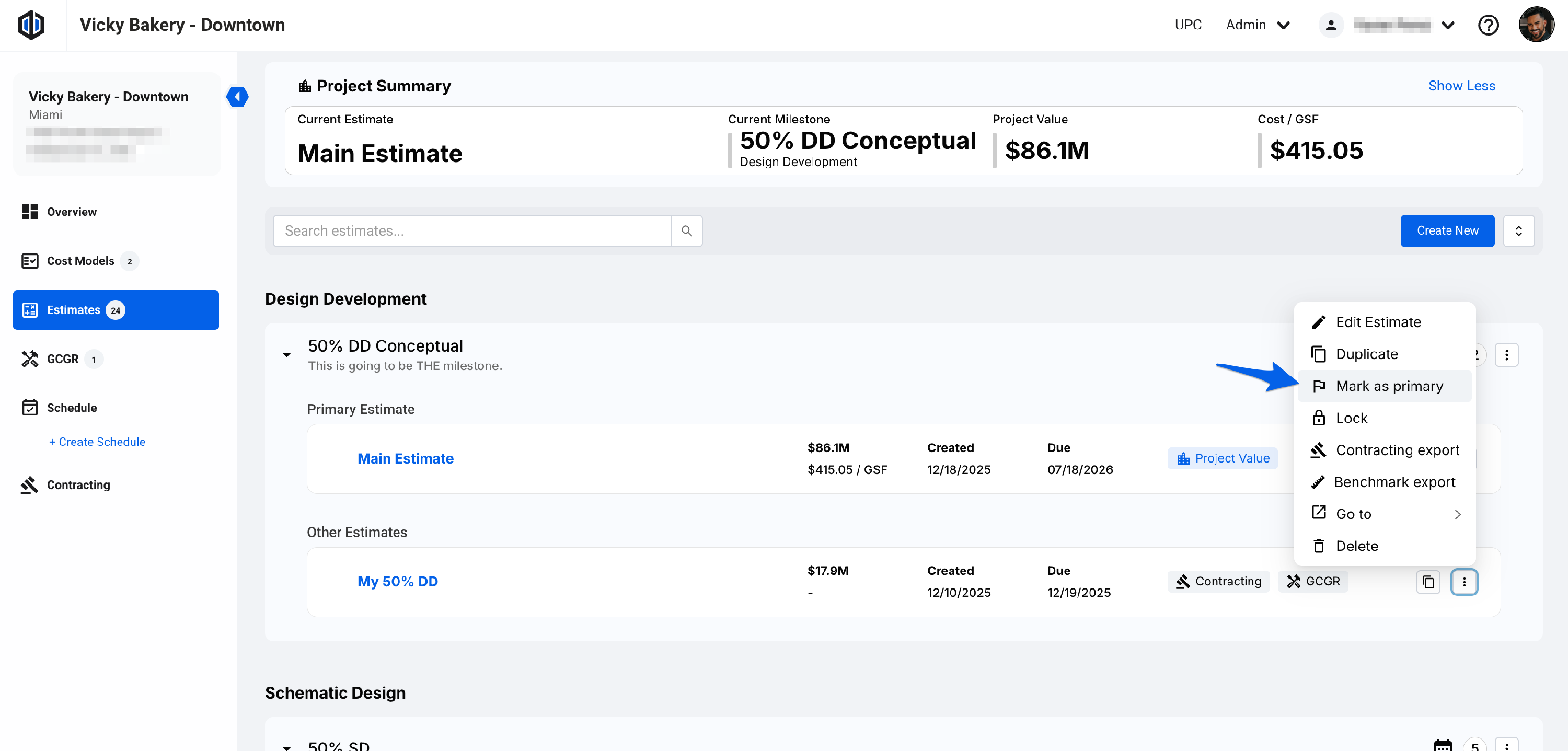
- When an estimate is set as Primary, it’s automatically placed in the “Primary Estimate” bucket for that Milestone. All other estimates appear under “Other Estimates.”
- The Primary Estimate within the most recent Milestone (based on Start Date) determines the Project’s Value.
- If a new estimate is marked as Primary within a Milestone that already has one, the previous Primary is automatically replaced.
Note: You can’t delete an estimate while it’s set as Primary. To delete, remove it as Primary first.
How to Mark an Estimate as Primary
You can mark an estimate as Primary in several ways:
- During estimate creation.

- When duplicating an existing estimate.

-
From the More Menu (…) on an estimate within the Estimate List.
Estimate Tags
Estimate Tags help surface context without the need to dig through Milestones or estimates manually.
- Project Value - Identifies which estimate is driving the overall value of the project.

- Submitted - Identifies which estimates have been submitted to the Cost Trendline.

-
Benchmarked - Highlights estimates being used for comparison in Cost Modeling.

- GCGR - Highlights estimates that have a GCGR linked to them.

- Contracting - Highlights estimates that have been exported to Contracting.

How Project Value Works
The Project Value tag is automatically assigned based on the following logic:
- The Primary Estimate within the most recent Milestone (based on Start Date) determines the project’s value.
- If the project has no Milestones, the Primary Estimate under the Estimates bucket determines the project’s value.
- If no Primary Estimate exists (either within Milestones or the Estimates bucket), the most recently edited estimate will determine the project’s value.
Estimate Links
You can now jump straight to any GCGRs or Contracting exports linked to an estimate without opening it. Just open the more menu for that estimate in the Estimate List and hover over Go to to see the available links.

If you have any questions, feel free to contact our support team and we'll be happy to help!